
Take soundings before you ship
|
This post was written with the help of AI. |
I lead a Red Hat engineering team responsible for shipping multiple cloud services to production. Every week we make a call: is this deployment safe to ship? When it isn’t, our job is to catch the risks and mitigate them before they reach production. The end goal never changes: keep production stable and reliable, with zero customer disruption.
What has changed is the volume. AI now generates and touches code at a rate no human review process was built for. Diffs grow, release cadence accelerates, but reviewing everything carefully doesn’t scale. The only review that scales with AI is AI: a reviewer that reads everything, with judgment, before anything ships.
That reviewer is Soundings, a Claude Code plugin I built. The name comes from an old sailors' practice: measuring the water’s depth ahead before committing a ship to a course, "taking soundings". This post explains what the plugin does, why I think you should try it on your next release, and why it is safe to run on your laptop even though its job is to read text it has no reason to trust.
|
Red Hat associates: this post is about the general-purpose Soundings plugin. To analyze the deployment MRs you ship through app-interface, pair it with the soundings-app-interface adapter. That adapter has its own internal post: Is this deployment MR safe to merge? Ask a Claude Code plugin. |
What Soundings does
In your Claude Code session, point Soundings at one or more GitHub or GitLab compare URLs:
/soundings:analyze https://github.com/org/repo/compare/v1.0...v1.1It reads the diffs, the commit messages, the PR and MR comments, and the repository documentation. Then it hands back one clear verdict (release, manual review, or no-go) and a report specific enough to act on: named files, named functions, concrete failure modes, and action items sorted by urgency. Before it starts, it asks where to save the report, unless you already said so:
/soundings:analyze https://github.com/org/repo/compare/v1.0...v1.1 save the report to ./reviews/v1.1.mdA few minutes after you hit enter, the verdict shows up right in your session: the summary, the recommendation, and what drove it. The full report is the markdown file, written by the helper, ready to archive or to post where the ship decision happens.
The verdict follows a fixed policy: by default, any critical concern blocks the release and any high concern requires manual review. Every concern is a concrete claim you can go verify, so if the verdict feels wrong, you can check which concern caused it and whether that concern is true. You can also tighten the policy and block on high or even medium concerns for your most critical services.
There is nothing to deploy and no LLM API key to create: the analysis runs in the Claude Code session you already have.
A small open-source Go helper does the deterministic work, borrowing the Git credentials you already use: a gh or glab login, or a platform token.
A run has three stages:
-
Fetch. The Go helper clones the repositories, computes the diffs locally, and writes per-file patches into a temporary directory it owns, with an index describing how much each file changed and its risk tier. It returns only counts and paths, never content.
-
Assess. An isolated subagent called
risk-analystdecides how deeply to read each file instead of cutting every diff to a fixed size: database, auth, and API contract changes are always read in full, tests only when they back up a claim about coverage. It assigns each concern an evidence-based severity, the higher one when evidence is incomplete, and returns one structured JSON analysis. -
Render. The helper validates that JSON against a schema, computes the verdict from the severities and the blocking policy, renders the report, and writes it to the file you chose. When it succeeds, the fetched data is deleted.
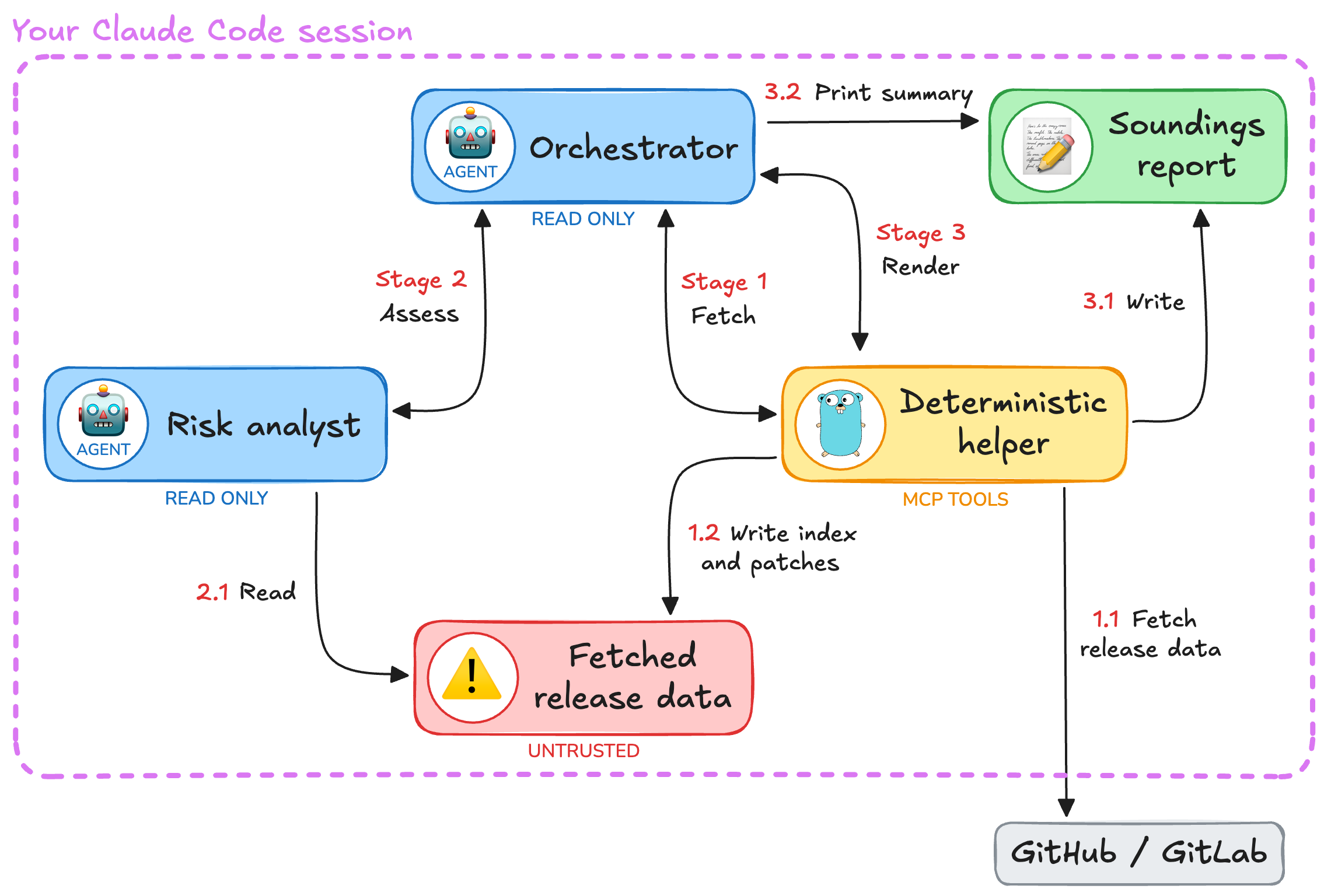
You can pass several compare URLs in one invocation, and they are analyzed together. A coordinated deployment usually spans repositories. The schema migration lives in one service, the code that depends on it in another. Per-repo CI can never see that interaction. A single analysis across all the repos of a deployment can, and compound risks are what Soundings hunts for. For a team shipping coordinated deployments every week, this is the feature that matters.
What a report looks like
Soundings looks for the risk families you would brief a new release manager on:
-
Database changes: migration ordering, rollback traps, locks taken under load
-
Security: secrets in diffs, auth changes, new logging on sensitive paths, risky dependency updates
-
API contracts: breaking changes, services no longer agreeing on request and response shapes
-
Infrastructure and configuration: deployment and CI changes, resource limits, config changes paired with the code that reads them
-
Resilience: retry, timeout, rate limit, circuit breaker, and connection pool changes, which all shift capacity and failure modes
-
Compound risks: changes that are each fine alone but dangerous together, including across repositories
Your session shows only the Summary section. The full report is in the markdown file. Here’s the top of one, from a demo analysis of a two-service release:
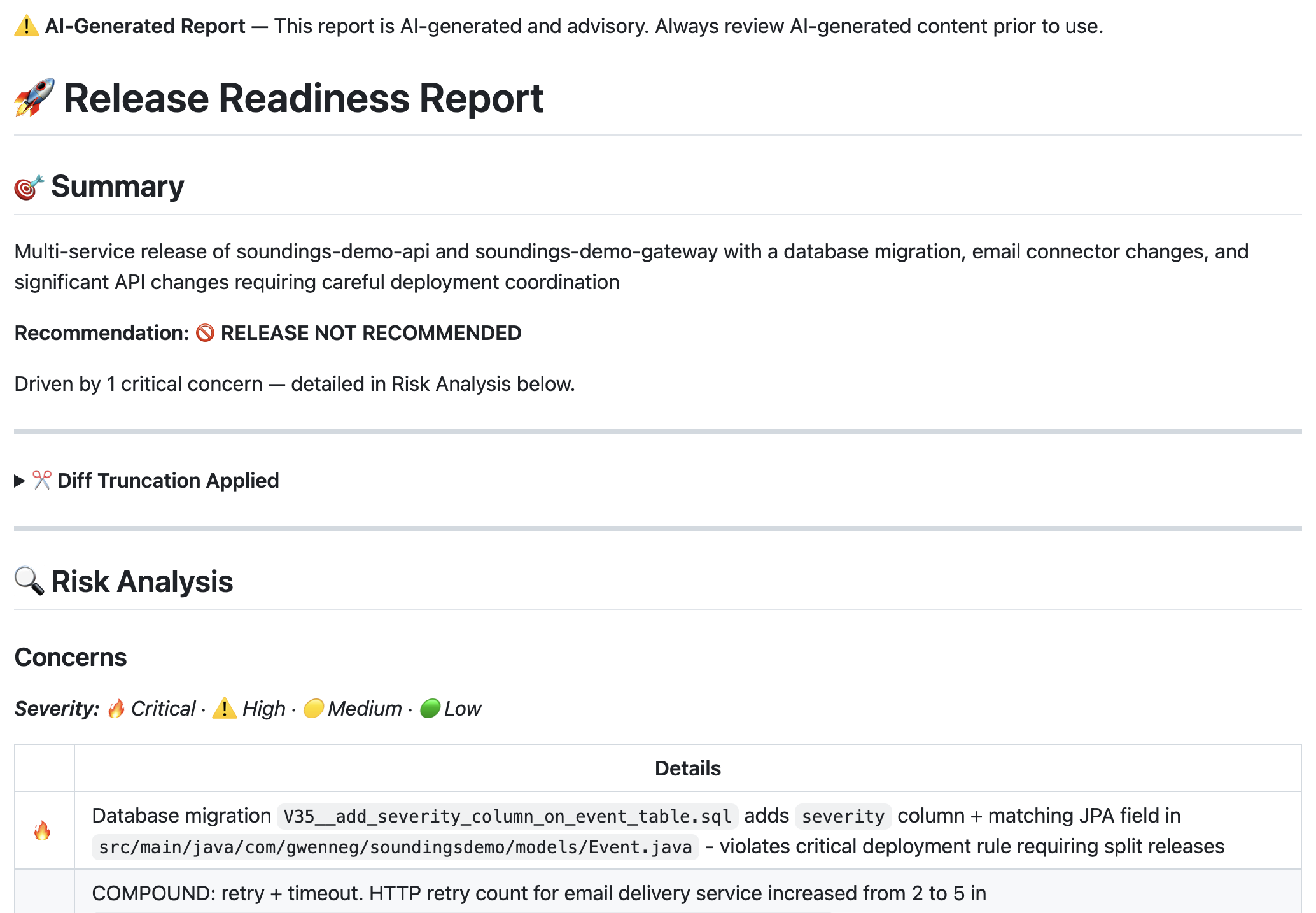
You can read the full demo report to see everything it contains.
Two findings from that report stand out. The critical one caught a database migration and the code using its new column shipping in the same release, a sequence the service’s own deployment rules forbid. Its action item: block the deployment and split the release, migration first, code second. The compound one caught a retry count raised from 2 to 5 in one file and a timeout raised from 200ms to 1s in another. Each change is fine alone. Combined, the worst case blows past the service’s 2 second SLO when the email service degrades. No single-file review connects those two lines.
The positives are evidence-based too, and just as specific.
The same report credits the release for a feature flag guarding the new endpoint, an IF NOT EXISTS guard on the migration, a documented rollback path, and a gateway change verified compatible with both the old and new versions of the API behind it.
That last one is only visible because the two repositories were analyzed together.
Try it on your next release
Here’s the complete setup on a machine that already runs Claude Code:
/plugin marketplace add gwenneg/claude-ichiba (1)
/plugin install soundings@claude-ichiba
/reload-plugins| 1 | Full disclosure: claude-ichiba is my own plugin marketplace. It also hosts AI Mentor, the plugin from an earlier post that teaches you the Claude Code capabilities you’re missing. |
You need two things besides Claude Code: a Go toolchain, and a credential for each platform you analyze, either a gh or glab login or a GITHUB_TOKEN/GITLAB_TOKEN env var.
That’s it.
No LLM API key, no service account, no Docker image, no config file.
At run time, Soundings picks the right credential for each platform and each GitLab host, so one invocation can mix github.com and any number of GitLab instances, and a token for one host is never sent to another.
Claude Code only updates plugins from its official marketplace automatically.
Enable auto-update for claude-ichiba in the /plugin panel, or refresh it yourself from time to time:
/plugin marketplace update claude-ichiba
/reload-plugins
Why it’s safe to run on your laptop
Everything Soundings analyzes (diffs, commit messages, PR comments, repository docs) could have been written by anyone. Even your own release carries text you didn’t write: other people’s code, bot commits, comments from anyone with an account. So the design assumes every byte it fetches is hostile, and the protections are limits the AI cannot cross, not instructions it is asked to follow.
What a run talks to
Those limits start at the network. A run adds no channel of its own: no extra LLM API, no telemetry, no server collecting anything. It only reaches the platforms that host your code, and the analysis stays in your existing Claude Code session, like the rest of your work.
Even that traffic never comes from the AI: the fetching is done by a Go helper with an SSRF-hardened HTTP client. The client blocks connections to private and internal addresses at dial time, covering redirects and DNS rebinding rather than just the initial URL. A document link planted in a repo cannot make your laptop probe your internal network or a cloud metadata endpoint. It guards your credentials the same way: a GitLab token is only ever sent to its own host, and gets stripped from any redirect that leaves it.
Who gets to read the data
Once the data is fetched, the reading happens in a dedicated subagent called risk-analyst, and each agent in a run gets only the permissions its job needs:
| What | Main agent (your session) | risk-analyst subagent |
|---|---|---|
Shell, file edits, network |
Switched off during the run |
Never had them |
Your project files |
Can read them |
Cannot read them* |
The fetched release data |
Cannot read it* |
The only thing it can read* |
The helper’s |
Can call them |
Cannot call them |
The starred cells all describe the same mechanism: a fence around the fetched data, enforced by a hook the plugin ships.
It exists because read-only is not enough on its own: an injected instruction could still make the AI read ~/.ssh or a .env file and leak what it finds into the report.
The hook is backed by a registry of the exact directories the fetch step created, and the two agents sit on opposite sides of the fence: the risk-analyst may read only in there, every other agent may read anywhere but there.
If anything goes wrong with the registry, the hook denies rather than allows.
And the plugin cannot override your own Claude Code settings: anything you’ve denied there stays denied.
The result: a prompt injection buried in a diff reaches only risk-analyst, and can, at worst, change what the analysis says.
It cannot run commands in your session, and the hostile text cannot be pulled into any other agent’s context.
What comes out, and what remains
What comes out of a run is as controlled as what goes in. Every file is written by the helper, and it refuses to overwrite anything that is not a previously generated Soundings report. Recognizable credentials (platform tokens, cloud keys, PEM blocks) are redacted before the analysis is even validated, so a secret that slips into the assessment never reaches the report. Externally-authored text is escaped in the report, so a crafted comment cannot forge its structure. And the verdict is computed from the concern severities: flipping it would require fabricating or suppressing a whole concern, in plain sight, in a report a human will read.
Nothing stays behind after a run. The helper owns the fetched data from creation to deletion: a successful render deletes it, a failed fetch cleans up behind itself, and an abandoned run’s leftovers are deleted the next time the helper starts. Only the report survives.
The residual risk
One risk remains: a prompt injection can still bias the analysis wording or a concern’s severity. That risk is inherent to any LLM-based review, which is why every report opens with an advisory banner and why the footer names the exact model that performed the analysis. The severity-driven verdict at least forces that bias into the most auditable place there is: a named concern, in a report, right where you will read it.
And if you’d rather verify all of this than trust me: the helper is a small, tested, open-source Go program you can read in an afternoon, and it never runs arbitrary commands.
It runs as an MCP server that does nothing until a tool is called: no credentials read, no network touched.
You can also toggle it off entirely in the /mcp panel.
Getting better results
Two inputs make the analysis noticeably sharper.
A .soundings.md file in your repository root tells the analyst what the service is, how critical it is, and where the known risky areas are.
Good candidates: the SLO your callers expect, deployment rules such as "migrations ship in their own release", rollback procedures, and links to your runbooks.
That’s where the demo’s blocking concern came from: the analyst read the split-release rule in the repository’s own documentation and enforced it.
Documentation linked from it is fetched too, SSRF-hardened and size-capped like every other fetch.
A /soundings note comment on a PR or MR hands the analysis context a diff cannot show:
/soundings note The new index was tested on a staging copy with production data volume. Creation took 47 seconds, with no lock contention.Notes only influence the analysis when their author is the PR/MR author or an authorized approver, and that authorization is computed from the platform API, never guessed. Unauthorized notes are disclosed in the report but excluded from the analysis, so a random commenter cannot change the verdict. The demo report has an example: a commenter insists the release should ship regardless of the verdict, and the guidance table lists that note as ignored.
The full guide lives in the repo: Improving your release readiness analysis.
Where Soundings comes from
Soundings is the successor to Release Confidence Score, a tool I originally built at Red Hat, licensed under Apache-2.0. I extracted its core with the full git history preserved: the original commits, including the security hardening, are visible in the Soundings log. It is Apache-2.0 too, and the whole pipeline is open to inspection.
What’s next
Everything in this post runs interactively, on a laptop, with a human reading the report. The next step is to remove the laptop. The entire pipeline (the skill, the isolated analyst, the helper) is designed to also run headless: a containerized Claude Code session analyzing a release unattended, as a step of the release process itself, delivering its report where the ship decision is made. And because the verdict is computed rather than written, it can serve as a gate in a continuous delivery pipeline: a clean verdict promotes, anything else stops the line and hands the decision back to a human, with the report already explaining why. That’s why a normal run already needs no permission prompt, and why the injection containment doesn’t rely on a human watching: the guarantees that make Soundings safe on your laptop are exactly the ones an unattended run needs. The only thing a headless run has to provide is where to write the report, since nobody is there to answer the question.
I’m also exploring how to port Soundings to Codex. The split at the heart of the design, code for the deterministic work and an isolated agent for the reading, is not specific to Claude Code. Stay tuned.
Soundings is under active development, and feedback directly shapes what changes next: issues and ideas are welcome on the repository.
Take soundings before you ship!
Leave a comment